
Graham Projected and Actual Dates
A projected date is a calculation based on the sentence, offense date, credit rules, and information currently held by the agency. It can move. An actual release date records an event that has already occurred. KASPER uses “Anticipated release date” as its forward-looking public label. A conditional release date, maximum sentence date, parole eligibility date, and sentence discharge date each mean something else.
A pretrial detainee has no fixed sentence-release date. Release may depend on bond, a court order, dismissal, a new hold, or final disposition. Even after a judge signs an order, jail processing takes time. For a sentenced Graham County person, the sentence type and custodial agency decide which date can be calculated.
Find Graham County Release Dates
Build a chain from the court judgment to the current custody record. The Graham County District Court judgment supplies the sentence and jail credit. KASPER supplies KDOC’s current computation for a state prisoner. The sheriff can explain how a county jail sentence and any credit were applied. These sources answer related but distinct questions.
- Confirm the person’s identity, case number, sentencing court, offense date, and current custodian.
- Read the public court judgment for the prison or jail term, consecutive or concurrent counts, and ordered jail credit.
- For KDOC custody, search KASPER by name or KDOC number.
- Copy the exact field label and date. Do not rename conditional release as final discharge.
- For a Graham County jail sentence, contact the sheriff and court because no local public calculation policy was found.
- For a case-specific KDOC question, call Sentence Computation at 785-296-3317.
The broader Graham County release-record search helps distinguish a county release from transfer to KDOC or another custodian. A live jail roster, if one existed, would show current custody rather than a past release, but Graham County publishes no official roster.
Graham KASPER Date Fields
KDOC says a public KASPER detail may show the KDOC number, identity description, convictions, case number, current location, movement history, supervising parole office, photograph, and Anticipated release date. Fields vary by person and status. The system is updated daily except weekends, described elsewhere as each working day, so a same-day or weekend change may not appear at once.
Movement history can also clarify why a date or location changed. A county-jail departure followed by KDOC intake is a transfer into state custody. A later move to a supervision office reflects release from the prison portion but not necessarily sentence discharge. Accuracy concerns about a public KASPER entry may be sent in writing to kdoc_pub@ks.gov, while an individual calculation question belongs with KDOC Sentence Computation.
Open the official KASPER search and disclaimer before using the captured search screen.
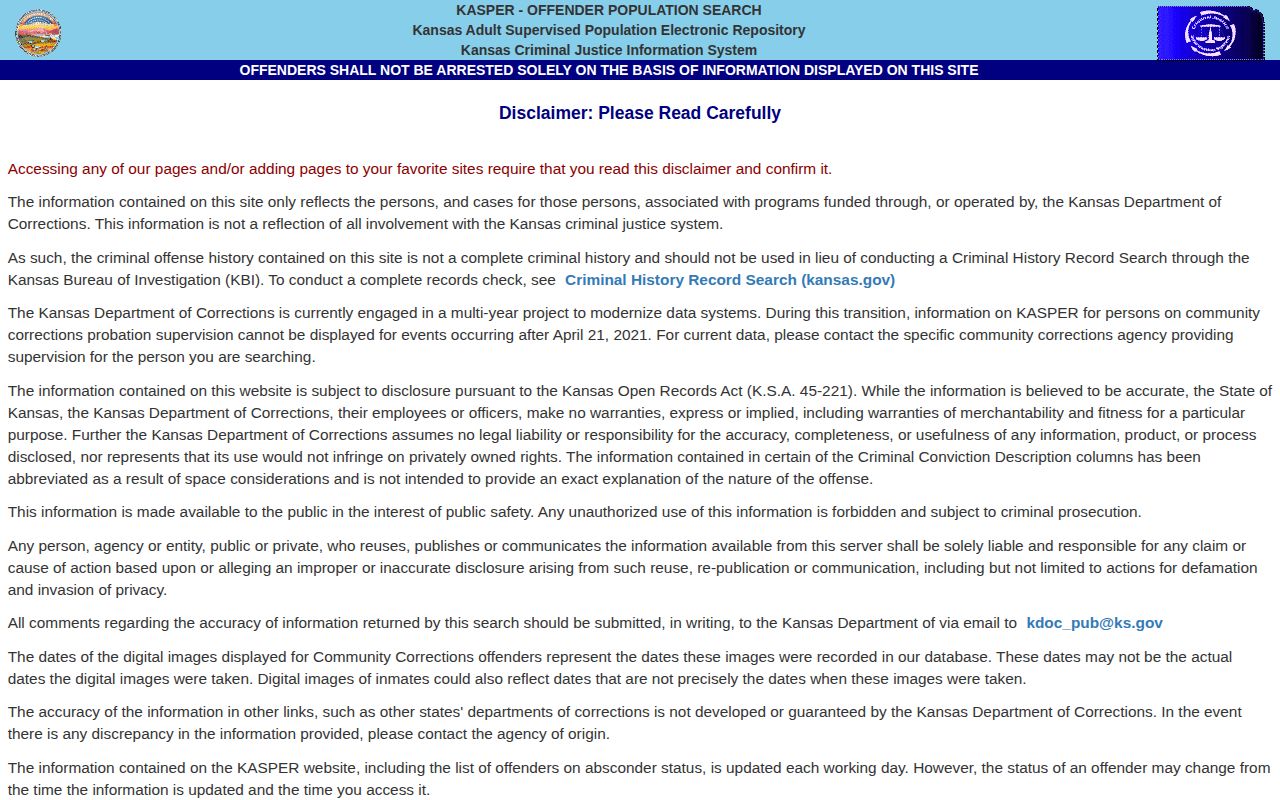
The image identifies the state search route; an individual result must still be checked for its current labels and identity details.
| Label | Meaning |
|---|---|
| Anticipated release date | KDOC’s forward-looking public estimate, subject to change. |
| Conditional release | A statutory calculation for an indeterminate term based on the maximum less retained good time. |
| Postrelease supervision | Community supervision after the prison portion of a determinate sentence. |
| Maximum sentence date or discharge | The end of the full KDOC sentence obligation, including supervision. |
Graham Good-Time Credit Rules
Kansas does not have one safe percentage for every sentence. Under K.S.A. 21-6821, the general good-time ceiling for many guidelines crimes committed on or after July 1, 1993 is 15 percent of the prison portion. This is the source of the rough “85 percent” shorthand. It is a ceiling, not an automatic award.
The statute supplies 20-percent categories for some nondrug severity levels 7 through 10 committed on or after January 1, 2008, certain drug severity levels 3 or 4 from January 1, 2008 through June 30, 2012, and drug severity levels 3 through 5 on or after July 1, 2012. Serious, off-grid, life, sexual, firearm, habitual, consecutive, and other special sentences may use different limits or eligibility rules.
Good time is earned through conduct and qualifying participation under KDOC rules. It can be withheld or lost. Eligible people may also earn up to 120 days of program credit for specified education, training, treatment, or risk-reduction work. Some credits shorten prison time but are added to postrelease supervision, so the total legal obligation may not shrink.
Jail credit is another input. The sentencing court identifies qualifying days already held, and KDOC applies the judgment to its computation. A corrected journal entry can therefore move an anticipated date without any change in conduct. The public record should not be recalculated by subtracting a percentage from the sentence. Only the controlling court documents and KDOC’s current computation can account for all counts and credits.
Program credit has its own limits. K.S.A. 21-6821 allows up to 120 days for statutorily eligible categories. Qualifying work can include a general education diploma, technical or vocational training, substance-use treatment, or another risk-reduction program designated by the Secretary. Completion of sex-offender treatment alone is excluded from that provision, and earned program credit may be forfeited. These details prevent a course-completion date from being mistaken for a fixed release date.
Some specified sexual or sexually motivated offenses treat credit differently by adding time removed from the prison portion to postrelease supervision. In such a case, the prison exit may move while the total sentence obligation does not shrink by the same amount. Read the KASPER status after release and the judgment’s supervision term before describing the sentence as complete.
Older Graham Sentence Calculations
Pre-guidelines offenses use another framework. K.S.A. 22-3725 applies to crimes before July 1, 1993. It describes indeterminate good time and expressly excludes later crimes. An indeterminate sentence has a minimum-to-maximum range. Parole eligibility can arise after a minimum calculation, while conditional release may occur later by operation of law if credit is kept.
Eligibility is only the first time the Prisoner Review Board can consider release suitability. It is not a release promise. For many modern determinate cases, the court sets a fixed prison term and postrelease supervision follows the credit-adjusted prison portion. The Board normally sets conditions rather than deciding ordinary parole suitability.
KDOC gives historical illustrations for indeterminate terms, but those examples cannot decide a real Graham County case. An offense carrying a one-year minimum may reach a different eligibility point from a term of two years or more. Conditional release can occur later than parole eligibility. Lost credit, statutory exclusions, or an amended sentence can alter both milestones. Check the exact offense-date law instead of borrowing an example from another record.
KDOC explains that an indeterminate term of at least two years may reach parole eligibility after one-half of the minimum when all available good time is earned. A one-year minimum may reach eligibility after nine months. For a three-to-ten-year illustration, KDOC describes conditional release after five years if no good time is lost. These are agency examples only. They do not account for the verified judgment, credits, holds, or later events in a specific Graham County case.
- Determinate term
- A fixed prison term set by the sentencing court.
- Indeterminate term
- A sentence expressed as a minimum and maximum range.
- Good time
- Credit that may be earned and retained under governing law and rules.
- Jail credit
- Days the court orders credited for qualifying time already held.
Why Graham Release Dates Move
KDOC maintains a sentence-computation unit because multiple legal inputs can control one date. A simple online calculator cannot safely account for each journal entry, offense date, count, credit, or later custody event.
| Change | Possible effect |
|---|---|
| Amended journal entry or jail-credit correction | Changes the sentence input or credited days. |
| Consecutive or aggregated counts | Changes the controlling total term. |
| Good-time loss or restoration | Moves the credit-adjusted prison date. |
| Program credit | May reduce eligible prison time within statutory limits. |
| New sentence, detainer, or hold | May prevent community release despite one completed term. |
| Revocation or escape time | May change custody and remaining sentence calculations. |
| Parole decision | Eligibility or a hearing does not guarantee a gate release date. |
Always read the newest dated record. If KASPER already shows postrelease or discharge, an earlier anticipated date has been overtaken by the observed status.
Graham County Jail Computations
KDOC credit rules cannot be imported into a Graham County jail term. The county website publishes no jail good-time formula, weekend-release rule, or public date calculator. Obtain the sentencing journal entry from the 17th Judicial District and ask the Graham County Sheriff how ordered jail credit and any locally authorized credit were applied.
Also ask whether the departure will be community release or transfer. Graham County houses contract prisoners for other counties, so leaving the local building can mean continued custody. If the person is delivered to KDOC, KASPER becomes the correct source after state intake.
The sheriff’s answer should identify the release authority or transfer destination if recorded. The district court can explain the public judgment and later orders, but it usually cannot certify the minute that jail staff completed physical processing. If one agency gives a date that differs from another, retain each source label and ask whether one is an order date, an anticipated date, or the actual jail departure.
No official Graham County source states that a jail sentence ends early for a weekend, holiday, or local good-time policy. Do not promise an adjusted pickup day. Ask the sheriff whether an existing policy controls the booking, then obtain the actual release entry after processing. If another county originated the case, Graham’s contract-housing role makes the originating court and receiving agency part of the calculation and destination check.
Confirm Graham Actual Release
A future date should be checked again close to the event. For county jail custody, Kansas VINE can send a custody-change alert, but it excludes KDOC state prisoners and a reported departure can be a transfer. For state custody, use KASPER and KDOC. The resolved VINE Inmate Check explains county-jail alerts and their limits.
After the date passes, seek an observed record: the sheriff release entry for a county booking, KASPER’s released or supervision status for KDOC, and the court docket for legal authority. Do not schedule travel or pickup solely from a projected field.
Federal custody uses a separate computation. The BOP locator may show a future projected date or a past release date, but it does not show whether state, county, immigration, or supervision custody continues. A Graham County case can also involve a detainer from another authority. Finish the check with the agency named in the record rather than treating one completed sentence as freedom from every system.
A detainer is a request by another authority to hold or take custody of the person. It may leave one sentence calculation unchanged while preventing community release at the end of that term. Court orders, parole processing, and receiving-agency transport can create the same difference between a sentence milestone and the observed exit. The final confirmation should state both what ended and which agency, if any, took custody next.