
Graham County Supervision Types
Parole, postrelease supervision, probation, and community corrections are separate legal paths. Parole generally follows release from prison in an eligible case, especially an older indeterminate sentence with a minimum and maximum term. Postrelease supervision follows the prison part of many modern determinate Kansas sentences. Probation is ordered by a court instead of, or after, confinement. Community corrections can administer more intensive probation under court authority.
The correct record depends on that path. A Graham County jail release on probation should be checked in the Graham County District Court case and with the assigned supervision agency. A person released from a Kansas Department of Corrections institution should be checked in KASPER, using the status and supervising-location fields shown on the individual record.
| Status | Who orders it | Best public check |
|---|---|---|
| Parole | Kansas Prisoner Review Board for an eligible prison case | KASPER, Board material, and KDOC Parole Services |
| Postrelease supervision | Part of a determinate prison sentence | KASPER and the listed supervision office |
| Probation | Sentencing court | District court docket and assigned agency |
| Community corrections | Court-supervised intensive program | Court record and Northwest Kansas Community Corrections |
Check Graham County Supervision
Start with the sentence, not a guess based on where the person was last held. Graham County Jail can record a physical departure, but it does not decide whether state parole, postrelease supervision, or court probation follows. A transfer from the jail to KDOC is continued custody, not a community release. The Graham County released-inmate search path can help establish which system took over.
- Review the Graham County District Court docket for the sentencing order, later revocation entries, and any discharge order.
- For a KDOC case, search KASPER by name or KDOC number and read the exact status, location, and supervising-office labels.
- Compare identity details before relying on a match. A shared name is not enough.
- Use the KDOC contact table and ask which unit manages the named case.
- If the record concerns county probation, ask the court or assigned agency for the proper public verification channel.
- Look for a discharge certificate or final court order before concluding that supervision has ended.
Graham County Supervision Office
No standalone parole office was verified in Graham County. KDOC’s current contact table directs Graham matters to a regional office in Hays. Because parole, postrelease, and court probation do not always use the same staff, callers should name the person and case type and ask which unit has authority. They should not travel to the Graham courthouse expecting a parole desk.
Northwest Kansas Community Corrections1011 Fort Street
Hays, KS 67601
785-625-9192
The regional assignment is the most specific published supervision contact found for Graham County. The office can route a status question, but confidential case notes, treatment information, and reporting details may not be public. Ask for the public status and responsible office rather than internal case-management material.
Graham County Absconder Checks
KDOC publishes separate parole and community-corrections absconder searches. The parole absconder search supports name and location filters. An absconder is a supervised person whom the agency reports has failed to remain in required contact or at the required location. That label is not a new conviction, and it does not erase the earlier lawful prison release.
These are exception lists. They are not directories of everyone who reports as required. A person can be lawfully released and supervised without appearing on either list. Never attempt to arrest, detain, or confront someone based on a web result. For urgent official action, contact law enforcement; for record verification, contact the supervising agency.
The official search interface shows how KDOC frames the warning and filters. View the KDOC parole absconder source before reading the captured screen.
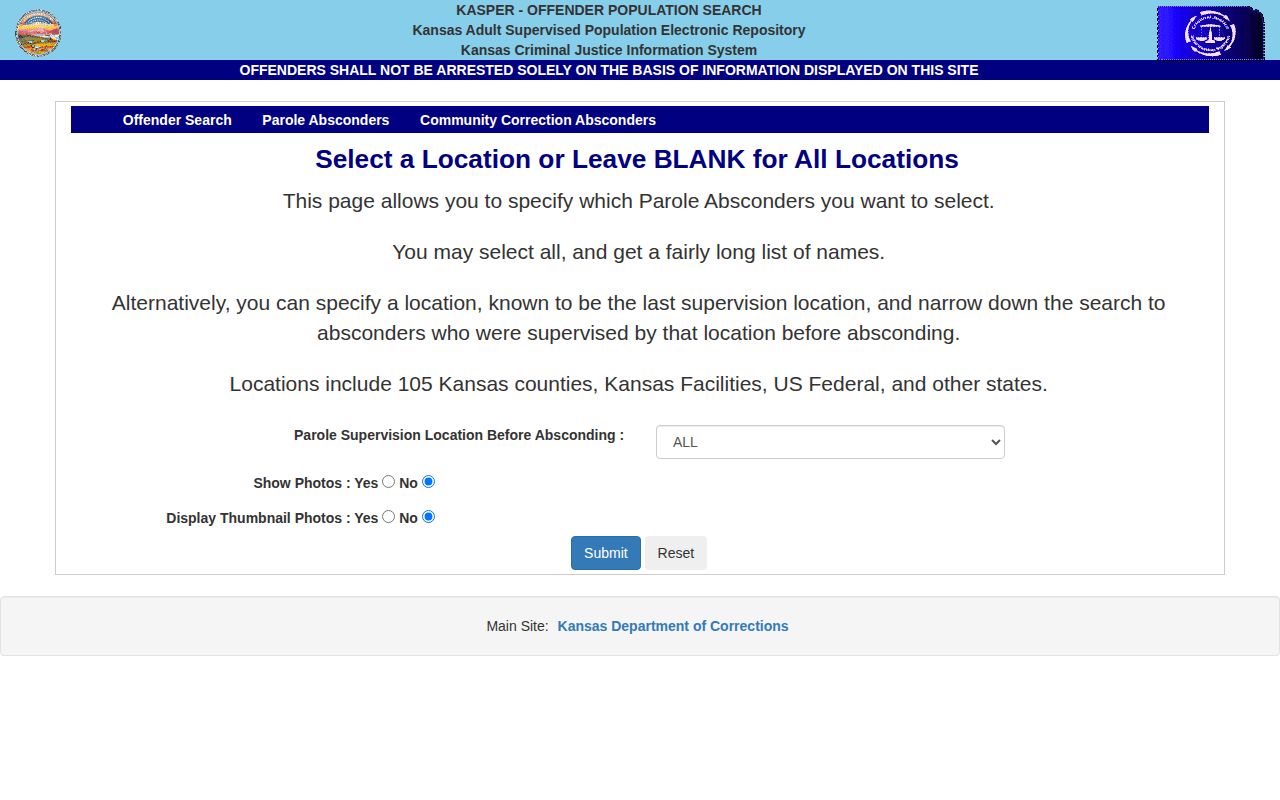
The image is a portal illustration, not proof about any named Graham County person.
KASPER separates the parole-absconder and community-corrections-absconder tools. The parole list may be narrowed by the last supervision county or location. Community corrections is organized by its administrative unit or location. For Graham County, that difference matters because a court probation case may be assigned regionally and may never have involved a KDOC prison sentence. Search the list that matches the actual supervision type, then verify the result with the listed agency.
Graham County Parole Hearings
The Kansas Prisoner Review Board handles the release-decision work once linked to a separate parole board. It publishes monthly public-comment material and an upcoming-offender list, not a Graham-only calendar or a full searchable database of individual outcomes. A calendar appearance means consideration is scheduled. It does not show that parole was granted or that release processing is complete.
For an older indeterminate sentence, compare KASPER’s sentence and eligibility labels with the Board’s current material. Then check KASPER again after the hearing. The agency uses three useful result terms. “Parole” means the Board found the eligible person suitable, subject to processing and conditions. “Continue” delays a final decision for more information or deliberation. “Pass” denies parole for a stated interval.
K.S.A. 22-3717 contains offense-date rules, exclusions, minimum terms, conditional-release provisions, and postrelease requirements. Eligibility is not the same as suitability. Charge name alone cannot establish either one. Use the journal entry, offense date, sentence form, and current statutory subsection.
The Board publishes public-comment material in monthly groups, generally before the related parole hearing. A listing may identify the conviction county and a possible earliest release month. Conviction county is not necessarily the person’s current home or planned release county. If Graham appears beside a name, that fact ties the conviction to Graham County but does not establish where the person will report after release.
No complete public database of individual Board decisions was located. After a hearing, recheck KASPER for a current status or movement and look for a published action or minutes document. If the decision is not public there, contact the Board through its official page or request the individual public record. A favorable action still comes before release-plan review, administrative processing, and the actual prison departure.
Graham County Supervision Violations
A later violation creates a new custody event. Under K.S.A. 75-5217, the Secretary may issue a warrant after an alleged parole, conditional-release, or postrelease violation, and a parole officer begins revocation procedures. A preliminary probable-cause step may come before return to KDOC and a final Board hearing. Rules can vary with the offense and sentence dates.
Return to custody does not make the earlier release record false. It means the person left custody and was later detained on a new supervision event. The court docket, KASPER movement history, warrant status, and revocation decision should be kept in time order.
The sequence can include a warrant, arrest, preliminary review, return to KDOC, and a final revocation decision. Not every step will appear in one public portal at the same time. When a Graham County record changes from supervision to custody, preserve the older release date as a historical event and record the later warrant or revocation separately. This avoids the false conclusion that the first release never happened.
- Absconder
- A person reported by the agency as out of required supervision contact.
- Revocation
- A formal process that may return a supervised person to custody.
- Discharge
- The end of the sentence obligation or supervision, shown by an official record.
- Detainer
- A request by another authority to hold or take custody of a person.
Ending Graham County Supervision
Leaving prison is not the same as completing the whole sentence. For some indeterminate cases, an early-discharge request may begin after at least one year through the parole officer, Board, or supervised person, subject to law and satisfactory adjustment. Without early discharge, supervision can continue until maximum expiration. The Board then issues a maximum-sentence discharge certificate.
That certificate is stronger proof of full KDOC discharge than a release date alone. For probation, look instead for the court’s discharge entry or other final order. KASPER’s status, a regional office statement, and the court docket may update at different times, so preserve the exact date and label from each source.
Conditional release also differs from final discharge. It is a statutory milestone in an indeterminate sentence based on the maximum term less retained good time. Postrelease supervision is the community portion of a determinate sentence. Neither status means all KDOC authority has ended. When records conflict, ask the responsible office which later event controls and request the public document that records it.
For indeterminate supervision, Kansas materials allow an early-discharge request to be initiated by the parole officer, the Board, or the supervised person after at least one year, subject to governing law and satisfactory adjustment. Initiating a request does not grant discharge. Unless an early discharge is approved, supervision continues toward maximum expiration. A Graham County verification should therefore distinguish an application, a recommendation, and the issued certificate.
Graham Release Identity Documents
Identity documents can matter once supervision begins. The Graham County Treasurer directory lists driver’s-license renewal service at the same courthouse address used by the sheriff and district court, Tuesday through Friday from 8 a.m. to 4:30 p.m. This is a navigation option, not assurance that a specific replacement or renewal can be completed.
Call first. Confirm which documents are required, whether the service needed is offered, and whether an appointment applies. The supervising officer can explain any case-specific reporting need, but the licensing office controls document eligibility and issuance.
Keep each task separate. A license-service visit does not verify parole or probation, and a supervision record does not prove that a licensing transaction can be completed. The value of the co-located Graham County offices is practical routing, not shared custody of the same records.