
Kansas Corrections Release Paths
A person sentenced in Graham District Court can be committed to the Secretary of Corrections and assigned to any suitable KDOC institution. Leaving Graham County Jail for KDOC is a transfer. The person remains confined under state authority. The county booking record can document that first movement, while KASPER becomes the public source for the later state location and status.
A later prison exit may lead to parole or postrelease supervision. Parole generally applies under the Prisoner Review Board framework to eligible cases, especially older indeterminate sentences. Postrelease supervision follows the prison portion of many determinate sentences. Neither means the full sentence has ended. Final discharge, sometimes tied to a maximum sentence date, is a separate milestone. Exact KASPER labels must be preserved.
| KDOC milestone | Meaning | Next check |
|---|---|---|
| Institution placement | State confinement continues | KASPER location and movement history |
| Anticipated release date | Forward-looking date that can change | Current KASPER record and KDOC computation |
| Parole or postrelease | Prison exit into community supervision | KASPER and listed supervision office |
| Sentence discharge | KDOC sentence and supervision obligation ends | KASPER label and official discharge record |
Confirm a Kansas Corrections Release
KASPER, the Kansas Adult Supervised Population Electronic Repository, is KDOC's public search. Search by KDOC number when it is known because it is more exact than a name. Otherwise, enter verified name details and compare identifiers before opening a record. A same-name result is not identity proof.
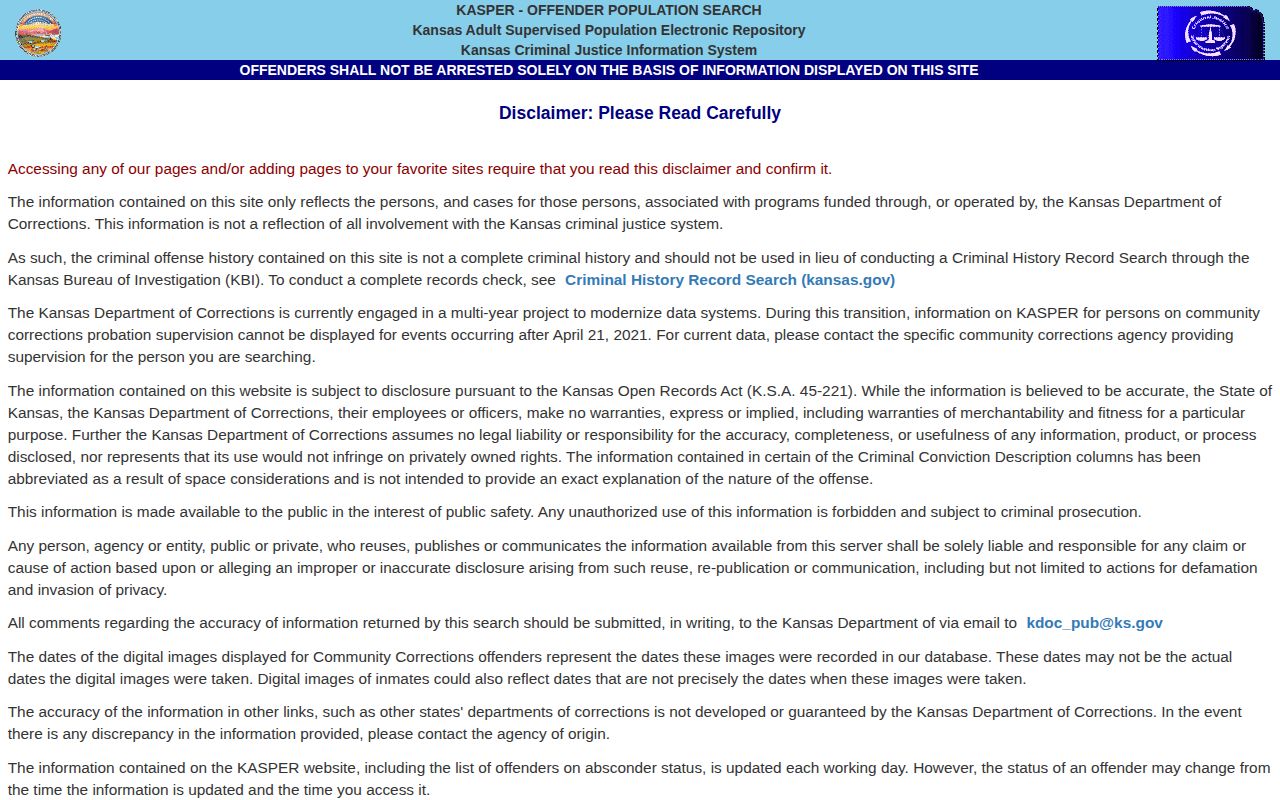
- Accept the KASPER notice and begin with the KDOC number if available.
- Use name or other offered filters only as needed to narrow a match.
- Compare identity information before relying on the detail record.
- Read current status, location, movement, sentence, and date fields by their exact labels.
- If supervision appears, verify the responsible office through KDOC's current contact directory.
- For an unclear sentence calculation, contact KDOC rather than converting a projected field into a promise.
KASPER is updated on working days, with KDOC also describing daily updates except weekends. A same-day or weekend change may not appear at once. State records can include people sentenced to the Secretary of Corrections since 1980 who are incarcerated, under post-incarceration supervision, or discharged. They do not cover a person held only in Graham County Jail.
Graham Cases in KASPER
KASPER search controls can include first, middle, and last name, aliases, KDOC number, State ID or KBI number, age or birth date, conviction county, facility, parole-supervision county, community-corrections location, and supervision type. Use Graham as the conviction county when that fact is known, but do not assume the person remains geographically near the county.
The detail record can contain a KDOC registration number, physical description, identifying marks, photograph, conviction and case information, current location, movement dates, supervising parole office, and an Anticipated release date. Availability varies. “Anticipated release date” is KDOC's forward-looking term. It must not be renamed as the actual exit date or final discharge.
- Anticipated release date
- A public planning date that may change as the sentence is administered.
- Conditional release
- A statutory calculation for some indeterminate sentences, not a discretionary parole grant.
- Postrelease supervision
- Community supervision after the prison part of a determinate sentence.
- Sentence discharge
- The end of the whole KDOC sentence obligation and supervision.
Graham Jail to State Custody
The Graham County jail record and KASPER should form a sequence, not compete with each other. The sheriff's entry can show the person left the county facility for KDOC. KASPER can then show reception, assigned facility, movements, and later status. A gap between transfer and the public state record may reflect intake or update timing.
The Graham court judgment establishes the legal commitment. It may also help distinguish a prison term from county probation. Ordinary county probation may never appear as a KDOC prison record. KASPER's disclaimer also says community-corrections probation events after April 21, 2021 cannot be displayed during the department's data transition. Recent probation questions should go to the court and supervising agency.
Graham Corrections Supervision Contacts
KDOC's current contact table maps Graham County to Northwest Kansas Community Corrections at 1011 Fort Street, Hays, KS 67601, phone 785-625-9192. Call to verify which unit manages the case and how it accepts a proper status inquiry. The statewide Parole Services Automated Reporting System number is 866-570-7225.
KDOC Graham County routing
Regional contact: Northwest Kansas Community Corrections
Address: 1011 Fort St., Hays, KS 67601
Phone: 785-625-9192
Automated reporting: 866-570-7225
KDOC Victim Services operates the state-prison and supervision notification channel at 866-404-6732 and VictimWitness@doc.ks.gov. Kansas VINE does not include KDOC state-prison offenders. A fruitless VINE search therefore does not contradict an active KASPER record.
Kansas Corrections Date Limits
A release date can change because of sentence structure, jail credit, earned credits, disciplinary forfeiture or restoration, consecutive or concurrent terms, revocation, new cases, or a statutory exclusion. Kansas does not have one reliable percentage that can be applied to every record. Offense date and sentence type matter. Older indeterminate cases and modern determinate terms follow different paths.
Use the controlling judgment to identify the sentence. Then read the live KASPER labels. KDOC Sentence Computation at 785-296-3317 is the appropriate agency contact when the calculation itself needs an authoritative explanation. A future date remains planning information until KDOC records the actual status change.
Kansas Corrections Release Records
KASPER may already provide the public status, photograph, case, location, and movement information needed. For a more formal discharge or movement record, direct a narrow request to KDOC and include the KDOC number. State corrections records, county jail records, and court records remain separate. The Graham sheriff cannot calculate a state release date, and KDOC cannot substitute for the sheriff's record of a county-only bond release.
The Graham District Court record supplies the conviction, sentence, revocation, and later public orders. The Prisoner Review Board supplies parole decision context for eligible cases. The assigned supervision office can confirm routing when KASPER has not yet caught up. Together those channels explain a state-prison exit without blurring parole, postrelease, and discharge.
Corrections Institutions Serving Graham
No KDOC institution was verified within Graham County. This page therefore describes a statewide system rather than a local prison building. KDOC controls placement, and people from Graham cases can move among institutions for classification, programming, health, security, or other departmental reasons. The current KASPER location is more useful than assuming the sentencing county predicts placement.
Facility geography does not define the legal case. A Graham conviction can lead to a prison far from Hill City, followed by supervision routed through a regional office. Conversely, someone physically present at Graham County Jail may have no KDOC sentence at all. Start with the custody class, then use the matching record system.
Trace Graham Corrections Movements
KASPER can show facility-movement history with movement dates. Those entries help trace the state-custody sequence after a Graham County commitment, but movement is not the same as release. A transfer between KDOC institutions keeps the person in state confinement. A move to a supervision location can reflect a prison exit, while the displayed status and supervision fields explain the legal posture. Read the movement, status, and date labels together.
The county and state records should connect at intake. Graham County Jail may record a transfer to KDOC. The Graham District Court judgment establishes the commitment. KASPER then supplies the state registration number, current location, and later movements. If a new state record has not appeared, allow for intake and working-day update timing before treating the absence as a contradiction. KDOC accepts written accuracy concerns at kdoc_pub@ks.gov.
A historical KASPER record may remain after discharge because KDOC's public coverage is designed to include many people discharged from sentences imposed since 1980. Absence can still have several causes, including a county-only case, an interstate-compact exclusion, a mistaken search, or a public conviction later removed by reversal, expungement, or executive clemency. Report only what the current record shows.
Graham State Release Notifications
KDOC Victim Services, not Kansas VINE, is the notification route for people in a KDOC facility or supervised by KDOC. The office lists 866-404-6732 and VictimWitness@doc.ks.gov. That division of responsibility matters after a Graham jail transfer. County-jail VINE notifications end at the county-custody boundary, while the state program follows eligible KDOC facility and supervision events.
For parole decisions, the Kansas Prisoner Review Board publishes its process and public-comment materials. Eligibility, a hearing, a grant, actual prison departure, and final discharge are distinct events. The court judgment and offense date help identify the governing sentence framework. KASPER shows the current public state record, and the assigned office can clarify supervision routing. No one source should be made to answer all four questions.